 Rajeev Narayan
India is no longer dealing with too little rain, too much rain or rain arriving at the wrong time. What feels different now is a growing sense that the weather has become harder to read, and even extremes are becoming more consequential closer to home. India’s monsoon has now stopped behaving like one weather event, and started behaving like several.
In Udalguri, on Assam’s northern edge, a single bridge collapsing in early August cut off the village of Kathpuri entirely from the rest of the state. There was no road in, no road out at the height of the monsoon. The event could be considered minor, compared to this year’s overall flooding. But it captures what the statistics cannot: What ‘too much weather’ looks like from inside one village.
The numbers for this monsoon tell a curious story. August, usually the wettest month, ended with rainfall 16 per cent below normal, and September is forecast below 91 per cent of the average. By month-end, India as a nation had received only 84 per cent of its normal cumulative rainfall. Yet, nobody looking at the headlines can call this an uneventful monsoon.
Assam has spent much of the season underwater. Floods and landslides there have killed hundreds, displaced hundreds of thousands, and submerged over 45,000 hectares of cropland. Bihar, Himachal Pradesh, Uttarakhand and Uttar Pradesh have each seen their own combination of swollen rivers, landslides and displacement.
Stark Reminder
And in late August, the Himalayas delivered a starker reminder. A glacier and rock collapse near the Nepal-China border triggered flash floods that killed hundreds and left thousands missing, sweeping away a key trade and pilgrimage crossing under clear skies, with no storm in sight.
This is not a foreign disaster with no bearing on India—the same glacial lakes sit above Sikkim, Himachal and Uttarakhand, where a near-identical collapse at South Lhonak Lake in 2023 destroyed Sikkim’s largest hydropower dam and killed dozens. The cascades move faster than warning systems built for river floods, which is why the region needs shared, real-time monitoring of glacial lakes across borders, not just within them.
This is the paradox. India can have a rainfall deficit and still have too much rain. The problem is not the quantity of water. It is the timing, intensity and location.
When Rain Comes Wrong
A farmer does not grow his crop on seasonal averages; he needs water at exact stages of the crop cycle. A dry spell followed by a cloudburst is not an even exchange, which is why tens of thousands of hectares of Assam’s standing crop went under this year, not because the season’s total rainfall was extreme, but because too much of it arrived in short, violent bursts.
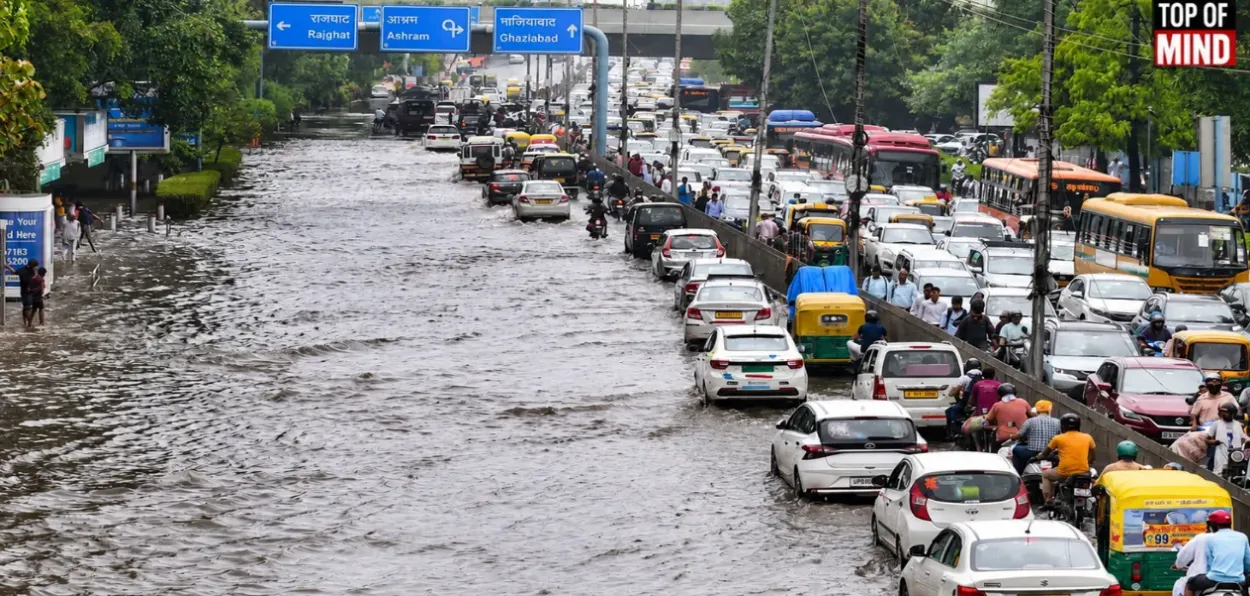
Cities face the same trap. A month’s rain falling in a few hours can overwhelm drainage that would cope easily if spread over days. The monthly figure looks ordinary; the flooded underpass does not. ‘Normal rainfall’ is a misleading average; a year can be statistically normal while being disastrous for a particular district, crop or city.
District-level data confirms the unevenness: 42 per cent of the 741 districts monitored ran deficient by August, 5 per cent severely so. Yet, 94 districts saw a surplus in the same period. That is not one monsoon; it is several, happening all at once, in a country where agriculture, food prices, power generation, insurance and urban infrastructure are all exposed to it.
Deadly Extremes
It is tempting to call every flood or landslide "evidence of climate change." That is too easy, and it is scientifically sloppy. Floods, droughts and landslides are not new, and India’s bank-breakers are worsened each year when riverbeds show a rise in sediments, failing embankments and settlements expanding into the floodplain.
But the larger climate signal is real. The World Meteorological Organisation says Asia is warming at nearly twice the global average, with terrible heat, devastating rainfall and retreating high-mountain glaciers. Climate change does not invent every extreme event, but it alters the ground conditions: warmer air holds more moisture and changing temperatures affect snow, glaciers and the mountainsides above them (as Nepal showed the world). The result is not a permanently wetter or drier India, but a less predictable one.
Price of Uncertainty
That unpredictability has a real cost. This year’s flood damage ran into thousands of crores in ruined crops, wrecked embankments and damaged roads. A damaged road delays goods; a flooded market means lost stock and trade; a crop damaged at the wrong stage lifts food prices months later; a shut mountain highway disrupts tourism and rescue efforts at once, as the loss of the Nepal-China crossing has just shown, at a cost running into billions once rebuilding is counted.
India’s development—the roads, tunnels, factories and cities it needs to build—makes this harder, not easier. Infrastructure designed around yesterday’s weather may not survive tomorrow’s too. The answer is not building for the worst storm imaginable; it is getting smarter about risk… with better local forecasting, glacial-lake early warnings and not just on rivers, drainage sized for rainfall intensity rather than historical averages, land-use planning that respects floodplains and unstable slopes, and insurance that recognises weather risk.
India has made progress on early warning; the next step is making intensity-based drainage codes and floodplain-respecting land use as routine to development as roads and power lines themselves.
Learning the Weather
Perhaps the biggest change needed is psychological. For generations, Indians treated the monsoon as a dependable annual appointment—late or early, generous or stingy, but broadly rhythmic. That confidence is harder to sustain now.
That said, we needn’t panic every time the sky turns dark, or blame climate change for every flooded street. But we should not treat a run of extreme events as isolated bad luck either. The world is warming, Asia faster than most, and crores of Indians are living and building in places where weather extremes can be debilitating.
ALSO READ: Shehnaz Rahman gives up lucrative legal practise for love of classroom
We cannot control the monsoon. But we can get better at anticipating what it may do. Better still, at we need to get better at ensuring that one bad afternoon does not become a national disaster. India’s problem may not be too much rain or too little; it may just be too much weather.
The writer is a veteran journalist and communications specialist.

_(1).jpg "Visitors gather at the Santosh Mitra Square Durga Puja pandal, themed on the 150th anniversary of Vande Mataram and its historic role in India's freedom movement, ahead of the festival, in Kolkata")

.jpg "Gujarat’s women entrepreneurs bring their craftsmanship to life during Navratri")










_(4).webp)
_(2).webp)