_(1).webp "Maimoona Nargis, India's first Shia woman Art Conservator")
Farhan Israili/Jaipur
When Maimoona Nargis was honoured by the Mehrangarh Museum Trust during its 568th Foundation Day celebrations at Jodhpur on May 12, the recognition symbolised much more than personal achievement. In the presence of Maharaja Gaj Singh of Jodhpur, Maharani Hemlata Rajye, Union Minister Rajyavardhan Singh Rathore, and representatives of the Shahpura royal family, the Jaipur-based art conservator was felicitated with a trophy, a citation, and a cash award of ₹75,000 for her exceptional contribution to heritage conservation.
The honour also celebrated decades of painstaking work dedicated to preserving India's artistic and architectural legacy.
Born in Amroha district of Uttar Pradesh, Maimoona Nargis grew up in a modest household where dreams were nurtured despite limited means. Her father served in the Uttar Pradesh Police and encouraged his daughter in her ambitions. She pursued a degree in Fine Arts at Aligarh Muslim University.
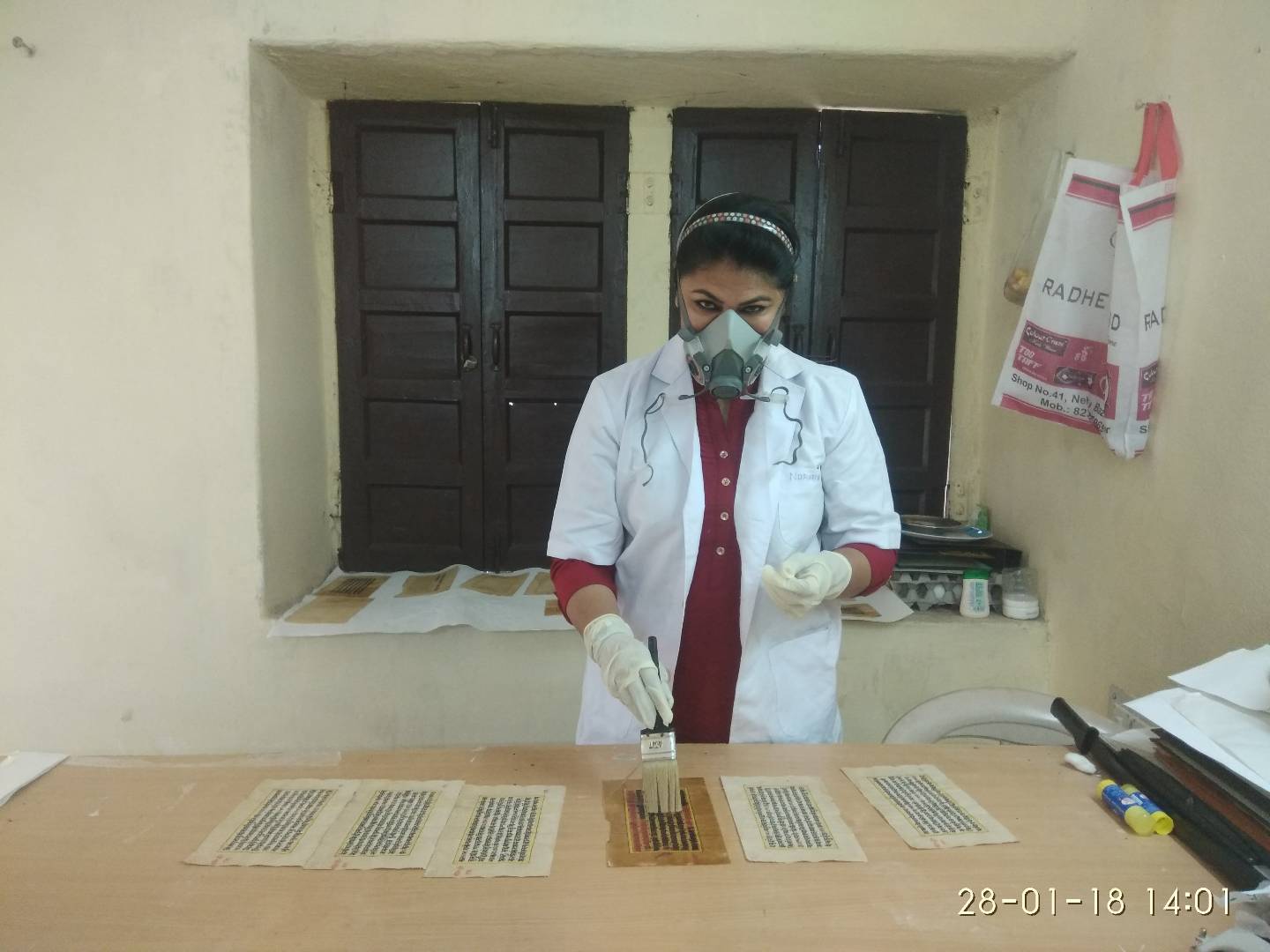 Maimoona Nargis restoring ancient scripts
Her career took a major turn when she enrolled for a diploma in Museology. What began as an academic interest soon evolved into a career and a mission—to preserve India's artistic and historical treasures.
Today, based in Jaipur's Amer area, Maimoona has emerged as one of India's leading heritage conservation experts. She is recognised as the country's first—and so far only—Shia Muslim woman art conservator, restoring centuries-old manuscripts, paintings, monuments, sculptures, and wooden artefacts that might otherwise have been lost forever.
After completing her museology studies, Maimoona joined the National Museum in New Delhi, where she simultaneously pursued a Master's degree in Conservation.
.jpeg) Maimoona Nargis restoring an ancient statue
Maimoona Nargis restoring an ancient statue
Her also joined two specialised programmes organised by the Government of India—one focusing on the conservation of wooden objects and another on the restoration of paintings.
Working on rare manuscripts, historic paintings, ancient wooden artefacts and invaluable archival documents taught her that conservation demands not only technical expertise but also extraordinary patience and sensitivity.
Rather than simply studying history, she began preserving it.
Maimoona's professional journey took a big flight in 2002 when she joined as Curator at Jaipur's Jaigarh Fort for eight months. The experience became a defining chapter in her conservation career.
.jpeg) Maimoona Nargis at work
Maimoona Nargis at work
She later joined the studio of renowned artist Jatin Das in New Delhi, where she restored nearly 100 damaged canvas paintings returned by collectors. The work refined her restoration skills but also exposed her to the challenges of working in a male-dominated profession.
As a woman who wears the hijab, she often encountered prejudice and scepticism regarding her abilities. There were even occasions when clients failed to pay her despite the completion of demanding assignments. Instead of allowing these experiences to discourage her, she transformed them into motivation to excel.
Through her organisation, Art Conservation and Restoration House, Maimoona has undertaken major conservation projects across Rajasthan and several other states.
She has worked in nearly 16 museums across Rajasthan. Her projects include manuscript conservation in four museums, preservation of stone sculptures dating from the 6th to the 13th centuries in ten museums, and civil as well as painting conservation in two others.
Between 2004 and 2007, she worked in the conservation laboratory of the National Museum, restoring priceless Mughal manuscripts such as the Baburnama, Akbarnama, Jahangirnama, and Shahjahanama.
Among her most notable assignments was the restoration of the original manuscript of Alif Laila (Arabian Nights), reportedly insured for nearly ₹36 crore.
.jpeg) Maimoona (Standing and wearing a white head scarf) being honoured for her work
Maimoona (Standing and wearing a white head scarf) being honoured for her work
At the Kota Museum, Maimoona conserved a 400-year-old manuscript of the Bhagavad Gita that had broken into several fragments. Carefully reassembling every page, she reinforced the manuscript with specialised backing to preserve it for future generations.
She also restored a 750-year-old Quran written in gold, one of the museum's most treasured possessions.
At the ancient Jain temple in Lodurva near Jaisalmer, she undertook the painstaking restoration of a 400-year-old wooden chariot that had been almost entirely destroyed by termites. The timber had deteriorated to the point of turning into powder, yet her conservation work succeeded in making the ceremonial chariot functional once again.
Her expertise also extended to restoring the 200-year-old Palitana painting displayed at Mumbai Airport. The massive canvas had torn into numerous pieces, all of which were meticulously repaired and reassembled.
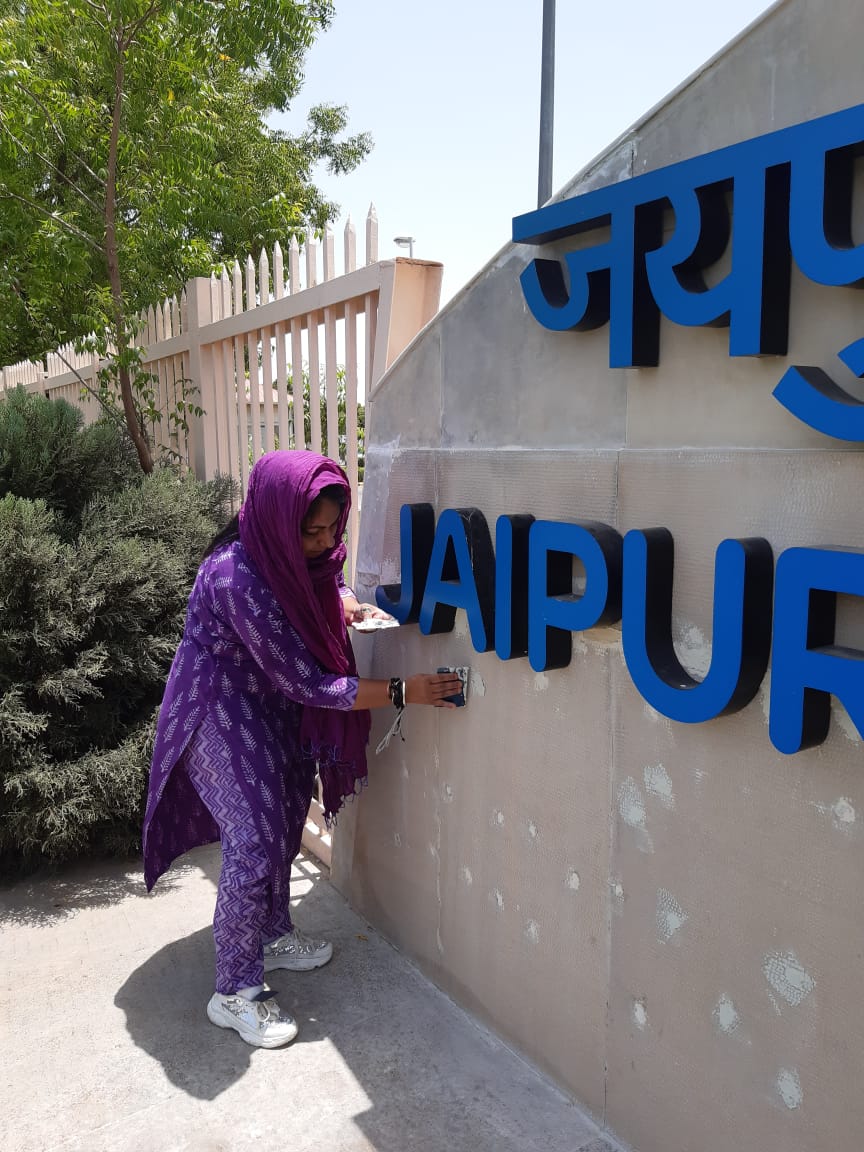 Maimoona beautifying the Pink City
One of Maimoona's challenging architectural projects was undertaken at Garh Palace in Jhalawar, where she restored centuries-old murals and traditional lime plaster on the palace walls and ceilings.
While several contractors had recommended removing the original plaster altogether, she insisted on preserving the historic fabric using traditional conservation techniques instead of replacing it with modern materials.
At Jaipur International Airport, she created murals inspired by Rajasthan's artistic heritage, depicting the Battle of Haldighati, Phad painting traditions, Sheesh Mahal motifs, and architectural elements drawn from Nahargarh Fort.
She has also restored frescoes and miniature paintings housed in Jaipur's Albert Hall Museum.
At Bharatpur Museum, she conserved taxidermy specimens alongside 30 rare miniature paintings created on mica—an assignment many senior conservators had considered exceptionally difficult.
Among her most unusual conservation projects has been the restoration of classified documents related to the 1971 India-Pakistan War.
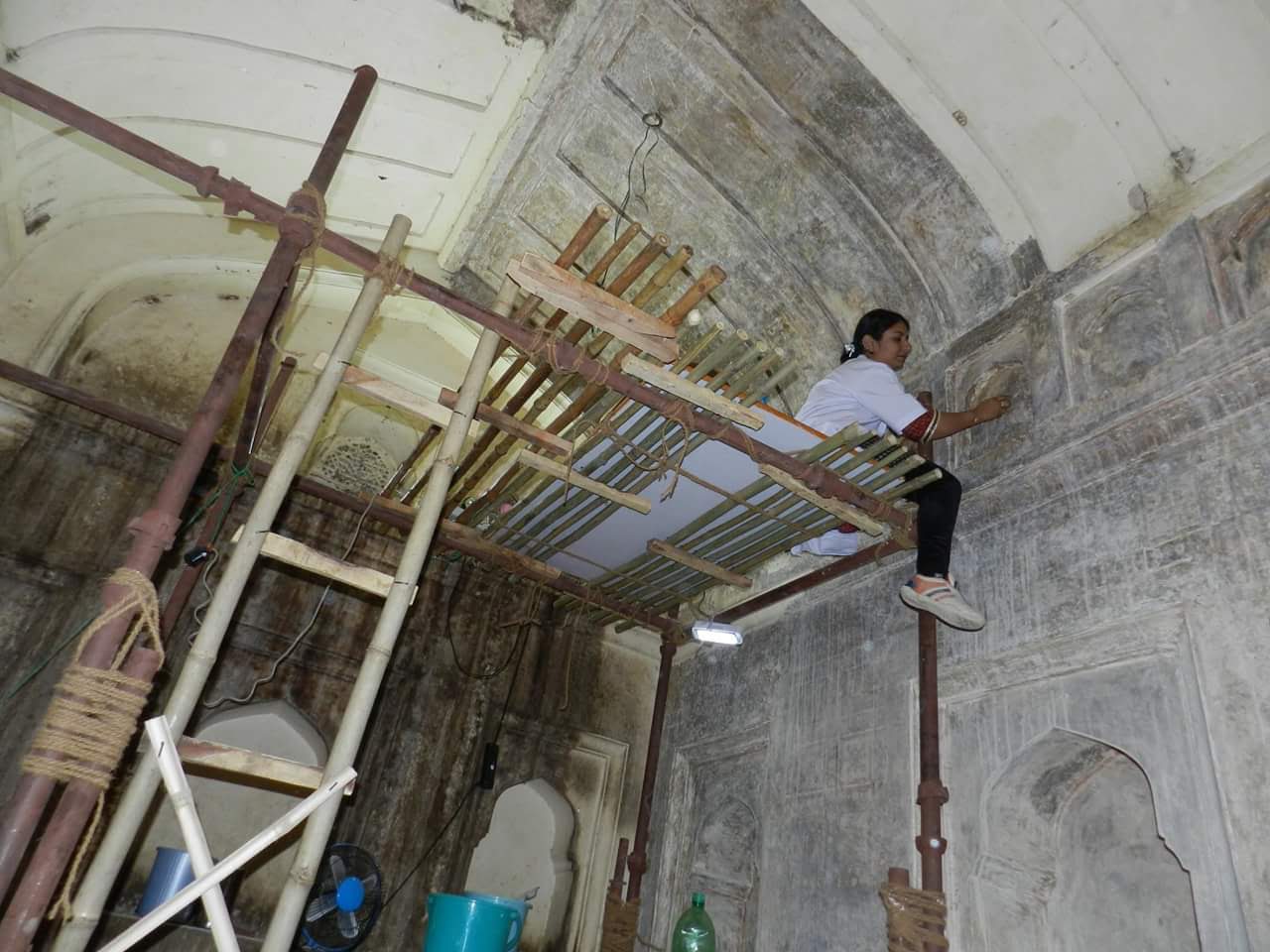 Maimoona restoring a monument
She has also worked for various military establishments, restoring preserved animal trophies including lions, tigers, pythons and gharials, ensuring that these historic collections remain intact.
Maimoona's work extends well beyond museums and archives.
She has contributed to heritage conservation projects at airports in Mumbai and Delhi while integrating traditional Rajasthani artistic styles—including Sheesh Mahal work, glass painting and mural art—into the architecture of Jaipur International Airport.
Her conservation assignments have taken her across Rajasthan, Delhi, Maharashtra, Gujarat, Punjab, Himachal Pradesh, Ladakh and Uttar Pradesh. She has also undertaken specialised restoration work for the private museum of the JK Group in Kanpur.
.jpeg)
For Maimoona, conservation is not limited to artworks and monuments—it also includes preserving traditional construction knowledge.
She advocates the use of age-old materials such as lime mortar, surkhi and Araish plaster, arguing that these techniques have enabled historic structures to survive for centuries, unlike many modern cement buildings with comparatively shorter lifespans.
Her expertise has encouraged architects, conservation professionals and builders to reconsider traditional methods in contemporary construction.
Alongside her restoration projects, Maimoona regularly conducts seminars, workshops and awareness programmes focusing on heritage conservation, women's education and the rights of marginalised communities.
She believes that preserving heritage is not solely the government's responsibility but a shared duty of society. Unless people actively protect their cultural legacy, future generations risk losing a vital connection with their identity and history.
Maimoona Nargis has received more than 32 awards and honours for her contribution to heritage conservation.
In 2018, she was recognised among India's 100 Talented Women at a national event held in Kurukshetra. She has also received honours from the University of Jammu, FICCI, and numerous cultural and social organisations for her outstanding conservation work.
Despite national recognition, Maimoona remains deeply involved in the physical aspects of restoration. She can often be found working alongside labourers, preparing lime mortar by hand, applying traditional plaster, or spending long hours on scaffolding restoring centuries-old murals under the scorching sun.
In a field historically dominated by men, she has demonstrated that dedication and expertise matter far more than stereotypes.
ALSO READ: Sharmila Dhankar's CWG gold is a tribute to women who dare to end abusive marriages
Through every restored manuscript, revived mural, repaired monument and preserved artefact, Maimoona Nargis continues to safeguard India's cultural inheritance. Her journey stands as a powerful reminder that preserving history requires not only knowledge and skill but also unwavering commitment. By breathing new life into fading treasures, she has ensured that the stories of the past remain alive for generations to come.













.webp)