 Rajeev Narayan
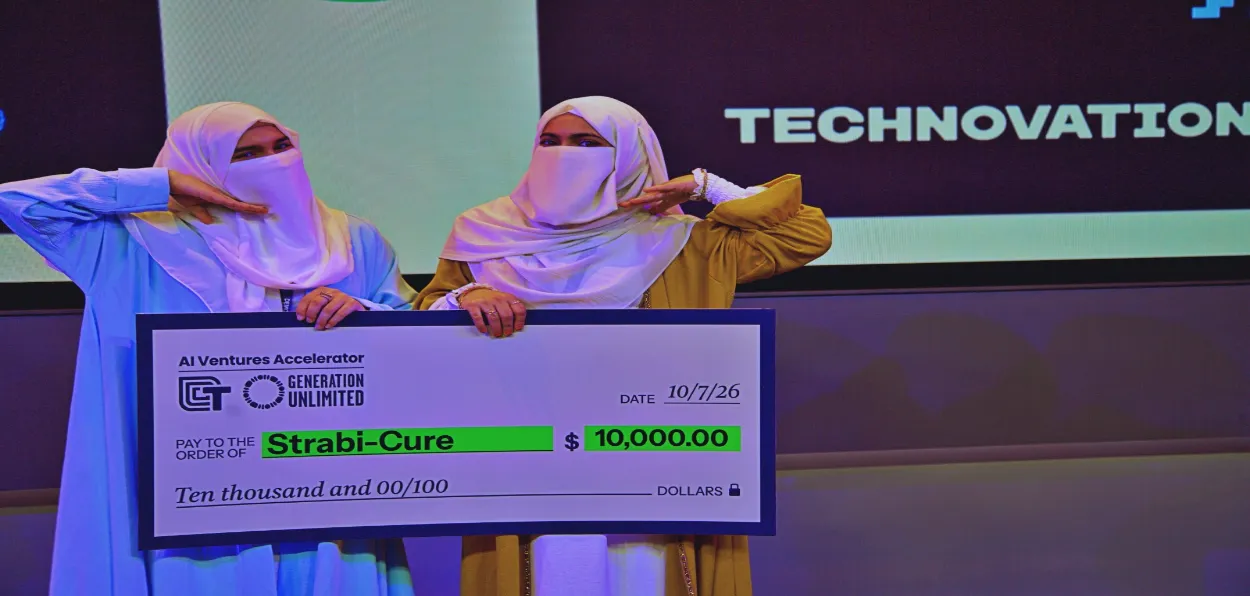
When Faria and Suha Zubair saw their brother Zain struggle with strabismus, they began asking questions that would eventually take them far beyond their own family. Their search led to Strabi-Cure, an AI-assisted project aimed at making screening easier and treatment more accessible. In the process, a personal problem became an idea with a much larger purpose.
It was all about the brother’s eyes. For Faria and Suha, artificial intelligence did not begin with a coding class, a technology conference or a futuristic idea about what machines might do. It began with their brother Zain. Zain had strabismus, a condition in which the eyes do not align properly.
Like many families dealing with a childhood vision problem, the two girls found themselves confronting something they did not fully understand. What they did realize was that the earlier such conditions are detected and treated, the better the chances of preventing lasting vision problems.
The two began looking more closely. And they were confronted with a problem that extended beyond their family. Strabismus can be difficult for even close relatives to recognise, particularly in its early stages, and access to screening and treatment can be uneven. The consequences are not restricted to eyesight. A visible eye condition can affect how children see themselves. And how others see them.
The questions kept multiplying. Could screening be made easier? Could technology help families identify a problem earlier? Could treatment be made more accessible at home? Those questions eventually became Strabi-Cure.
The project they came up with uses a smartphone camera to assist with screening, combines exercises with progress tracking and incorporates a low-cost home therapy device. “What began as a problem inside their family became an attempt to help many others facing the same condition.” That journey, from seeing a problem to deciding to build something about it, forms the core of their story.
Problem to Project
Faria and Suha did not begin with the resources of a technology company. They began with curiosity, research and the willingness to learn. The process required them to understand not only the problem, but also the technology that might help solve it. They had to think about users, test their assumptions, develop the product and learn how to explain their idea to people who had never seen it before.
 When Faria and Suha Zubair with Ambar Hernandez and Fátima Gaytán from Mexico
That is a considerable leap for anyone. For young women still building their own futures, it is larger still. And Strabi-Cure was not developed in isolation. The two became part of a larger experiment in what can happen when young women are given access to AI, mentorship and the confidence to tackle problems they understand personally. Their story is bigger than a medical app. It is about what happens when a young woman is encouraged to look at something familiar and ask a question: What if I try to fix it?
Thousand Questions
That question lies at the core of the AI Ventures Accelerator, an initiative of UNICEF Generation Unlimited and Technovation. More than 1,000 young women from 60 countries entered this year’s programme. Over 200 went on to complete working products, demonstration videos and pitches during the 12-week accelerator. Eleven ventures were eventually shortlisted, and their founders, aged between 19 and 24, presented their ideas at Google.
The scale matters; so does the philosophy behind it.
Thomas Michael Kaye, Senior Adviser, Global Solutions, Generation Unlimited, UNICEF, says the programme deliberately looked for young women who had already identified problems and wanted to do something to resolve them. “What these girls have shown is persistence, perseverance and the power of partnerships,” he says. “Our approach was simple. Seek out young girls and women who had identified local problems and wanted to bring about change. Through this programme and with AI tools, they have managed to do just that.”
For Faria and Suha, that meant taking something deeply personal and giving it a technological form. For others, the starting point was quite different.
Mexican participants Ambar Hernandez and Fátima Gaytán, for instance, developed CONCORA around a problem familiar to millions of young people: employers asking for experience that young people cannot acquire unless somebody gives them their first opportunity.
Learning to Build
The significance of the programme lies partly in what happens between the idea and the final pitch. Many participants had little or no experience of coding, product development, customer discovery or pitching. Over 12 weeks, they learnt how to turn an idea into something they could build, demonstrate and defend.
Rebecca Anderson, Chief Learning and Innovation Officer at Technovation, says watching this transformation in the girls was one of the most rewarding parts of the programme. “It has been exciting to see these girls grow with their projects in such a short time,” she says. And she argues that judging the programme only by the 11 shortlisted teams would miss the larger achievement. “It is not only these 11 teams that count. All 200-plus teams that completed the programme have won.”
That is an important distinction. The programme is not simply searching for the next successful start-up. It is trying to create a generation of young women who see technology differently: not just as something they consume, but also as something they can use to create.
More Than AI
That may be the most valuable thing Faria and Suha take away from Strabi-Cure. Their project may evolve. The technology may change. Medical validation, funding, regulation and implementation will determine how far it eventually travels. But the two have already crossed an important threshold. They saw a problem in their own home and refused to leave it there.
That is also what makes the wider AI Ventures experiment interesting. Quite often, artificial intelligence is discussed through the language of computing power, investment, automation and jobs. Those forces will shape the technology’s future. But there is another AI story developing much closer to the ground. And that story is being written by young women who know the problems because they live with them.
ALSO READ: Sarah Mehmood’s stories are happening in the world of India Muslims
For the two Zubairs, it started with a brother’s eyes. Elsewhere, it may begin with a job application, a classroom, a farm, a clinic or a problem that everyone has grown accustomed to accepting. Give the young woman who sees that problem the tools, the mentorship and the confidence to ask “Why not?”, and AI begins to look less like a technology imposed on people and more like a technology shaped by them.
The writer is a veteran journalist and communications specialist














.webp)